
With the surprising announcement from Valve yesterday and the onslaught of in-depth looks, we are official excited for Valve’s newest item: Steam Machine. Now if the name is ringing a bell, that’s because it isn’t the first time that Valve has used that name before! They were an attempt to bring a streamlined, PC gaming experience through third-party manufacturers that started in 2015 and ended in 2018. The key issue was just how unsupported Linux was as an operating system at the time and how unreliable it was to run games on it. Circling now to the launch of Valve’s Steam Deck and now, Linux has a competent, if not downright excellent support for the Linux, PC gaming market. With this renewed effort and direct manufacturing, Valve is ushering us into a golden new age with Steam devices at the forefront. But how are these new devices going to change how we play games or how we even view home consoles for that fact? Well for one, they are first to market over even that of Microsoft’s own efforts.
A Gaming PC That Blurs Console Like Qualities Over Standard PC Ones.
When it boils down, the Steam Machine launching Q1 of 2026 is a device that is taking the lessons of the handheld, Steam Deck, and applying them to a more living room style of experience. Home systems have enjoyed the successes that they have had primarily for one key reason: Ease of use. This alone can defeat any argument that might be given as to why a PC is just a ‘superior’ experience. Because if the solution is not as simple as say Nintendo’s Switch or Sony’s PS5, then the average consumer won’t want to mess around with overly complex methods of install. Be it ways of getting a launcher installed and then paring a controller. But then they find out that they can’t simply turn the system on by powering the controller up or they find the game they like doesn’t work with a controller. It’s the multitude of steps that loses a potential buyer, but it’s the simplification of them all that gains that buyer.
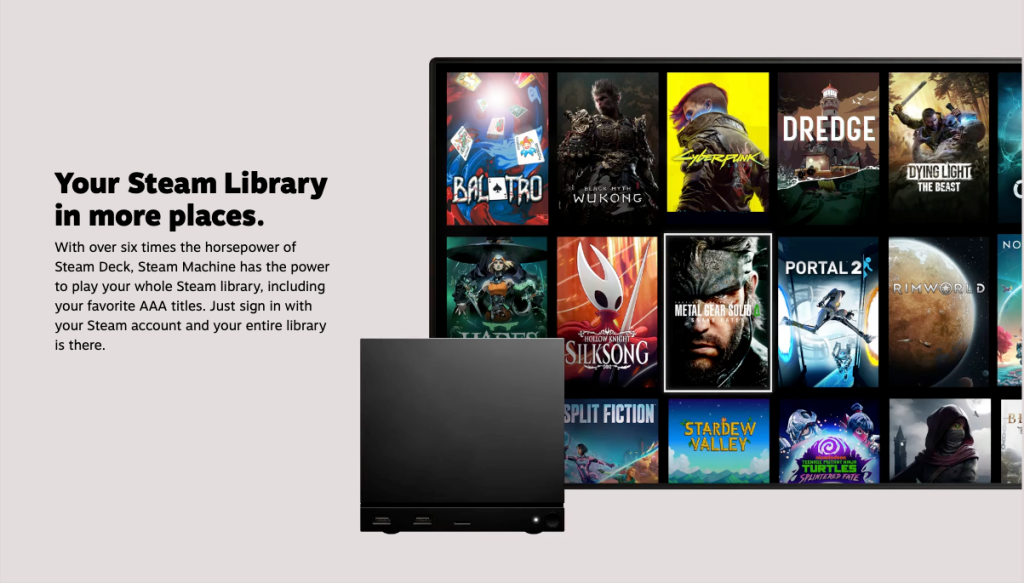
The key to a successful consumer attachment for a device of this nature is giving the consumer an ease of use akin to devices that they may already be familiar with. This is something I think Valve demonstrated quite effectively with their Steam Deck. While keeping the experience streamlined, they still offer advance settings and options to the more experienced user. All the while, maintaining a face of ease of use. The first time user will have a familiar facade of a console, but the longtime PC enthusiast will still have a lot of the performative access that they have come to expect from Linux PC’s and other similar devices. Yet it’s this unique mixture of trying to appeal to home system users and the seasoned PC gamer that makes this fascinating.
Yet for the more seasoned user the Valve Steam Machine will also offer user upgrades in the form of SDIMM slots and a variable sized M.2 SSD slot. How much SDIMM RAM the Steam Machine will fully support remains to be seen, but it is a great option to have. While I am sure PC users would have appreciated full sized RAM sticks, the laptop variants are better than nothing at all. That and the option to upgrade the SSD is a nice touch in extending the devices lifespan. The system itself will launch with either a 512GB or a 2TB SSD. Presumably the rest of the systems configuration will remain the same, as we saw with the Steam Deck.

Is it Enough To Change a Static Industry?
Aside from the unique quirks that Nintendo tries to bring to market with their systems. The rest have all fell rather complacent and in keeping with consumer expectations, for the most part. That being said, with the advent of Sony’s PlayStation 5, we did start to see more PC level aspects start to integrate into the general consumer’s sphere of influence. Chief among those being Sony’s inclusion of M.2 SSD’s and thus brining consumer focus into field on these incredible SSD’s. However that isn’t enough to outright say that a PS5 is very close to a PC in any way, shape or form. That being said, Valve’s Steam Machine is certainly treading that narrow territory with both its hardware and software implementations. The included Steam Controller, will take the lessons learned off the Steam Deck and bring those down. These include the incredible mouse touch pads for working with games that had only a mouse in mind, to the use of gyro or sleep to wake functionality. Aspects that are unique to only one home system at the moment, being the Nintendo Switch and Switch 2.
That being said, the Steam machine is still a PC first and foremost. So you can choose to operate it as such, with a mouse and keyboard for full integration for the titles you like. With it supporting KDE Plasma, you should be expected to have a similar desktop experience as you would with the Steam Deck. However if Windows is something you’d prefer, you are free to install that too. The key here is this devices ability to offer an out of the box, dual experience that has been seamlessly meshed into one offering. Giving both the enthusiast and general consumer a device that will offer all aspects that they need. But the biggest question left unanswered is the MSRP. Valve has made repeated quotes during recent interviews stating that choices were made with a specific MSRP in mind. This and keeping within an affordable range indicates to us that the device seems to be targeting a 399USD on the lowest end to a 599USD on the highest end. Where that MSRP will actually land of course will be subject to change, provided we don’t have any new tariff’s land between now and Q1 2026.
Are you interested in grabbing a Steam Machine next year? Do you already have an existing Steam Deck? Let us know in the comment section below!
Liked what we posted or noticed a typo? Want to suggest something for us to check out? Feel free to leave us a comment or send us an inquiry via our contact page




![[REVIEW]: Dispatch Answers The Call On Nintendo Switch 2! But Does It Stick The Landing?](https://otakugamerzone.com/wp-content/uploads/2026/02/img_3154.jpg?w=1024)
 OGZ
OGZ 
Leave a reply to vermavkv Cancel reply