
A story is only as strong as its characters, as the world that it paints and as strong of the performance of the people that give voice to its world. An anime like wise is only as strong as the foundation it’s adapted from and that has proven to not be a weakness of My Dress-Up Darling S2. If anything, it’s only proven that it’s been entirely capable of transcending even the written work, as evident with the latest episodes 17 and 18. The depth of character and moments that are expanded upon, such as the moment Marin tries to help see in volume 7, page 174. A tender moment that’s entirely representative of their dynamic, but the depth, the isolation of the moment, gives credit to both the growth and path yet ahead that Marin and Gojo have to walk. To Amalee’s infectious performance as Marin throughout the English dubbing of My Dress-Up Darling.
Everything that made season 1 of the show such a successful adaptation only extend further beyond into season 2. Be it the additions of more meaningful moments extended deeper into the anime or key moments visualized in a way that adds so much more insight to their budding and complex relationship. What makes season 2 of this show such a performative masterpiece is the way it portrays the growth of their ever evolving relationship without them having ever realized (aside from Marin) that they each feel that way towards each other. Where season 2 holds extra strength over the first is how it’s helped explore Gojo’s and Marin’s budding romance through small sections of silent or atmospheric moments. Ideas that may have been inferred during the manga or even entirely new ones. It’s the gentle moments where utter silence can speak louder than all the emotions of the actors or the animated moment of interaction.
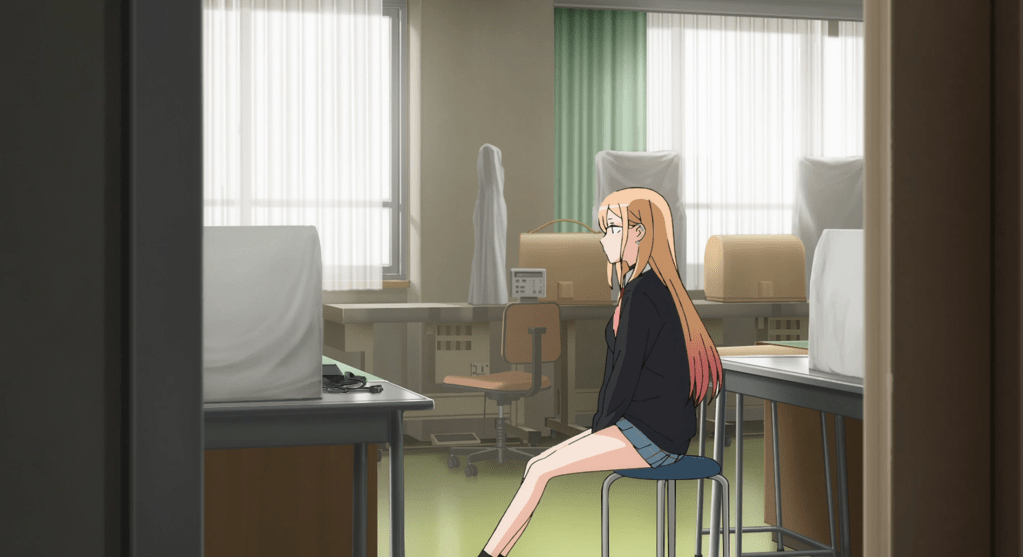
Take the seen from the episode, 800 Million. As their class prepares for the student festival, as Gojo and the group works hard on getting both her cosplay and the prop work for their cafe done, she’s left to her self, in a room that’s to synonymous with their first meeting. That fragile, moment of interaction that altered Gojo’s and her life. Yet the scene is elevated to a level that the manga had in four frames. There’s an unspoken sense of loneliness that this one moment in time represents. This subtle shift to her facing the camera, then to the soft drapes over a window, hints at the Summer just beyond. Then to her eyes, her piercing gaze and those colorful contacts sparkling ever more.

Take the following scene after the isolation, Marin takes it upon herself to try to help Gojo in whatever way possible. A simple task for him, but a daunting one for Marin, if season 1 episode 1 is anything to off of. It’s the fact that she made an effort to add a helping hand to what Gojo gives his all too. Yet, she fumbles trying her best to sew on one of the buttons. A notion that is simple yet deeper. As Gojo remarks on how she tried to sew a button but messed up, has him smiling. The uneven and twisted mess of thread a complicated representation of the love, journey and foundation for the representation that is their relationship. It’s messy and complex, but like everything else in life. It’s a good first try.

It’s not just with buttons and isolation that gives season 2 its weight. It’s also in the moments of relation that helps this season to stand out even more. We all have that hobby or interest that we often feel others can assign hate or judgment towards. That’s no better displayed than when they meet the crossplayer, Amane Himeno, a person that Gojo can find relation with. Both had suffered people in their past labeling what they did as “Gross or weird” things that they loved and admired, stepped on as if they were just simple garbage. Yet it’s also shown how even with acceptance there also comes fear of backlash still. As evident when two other girls approach them and out of caution they inform them that they are a crossplayer, only to find their utter support, shocking. They expected the response that they’ve grown used too. Something that Gojo has had too much experience with as well.

The fear of never knowing just how your interest is going to be received is recipe for knots. Yet, it’s through the cosplayers interacting with Amane that they find how supported they can be, and as with 800 Million and I’ll Make it Happen, No Matter What With These Two Hands for Gojo. A person who feels his quirks are too weird to have the support he receives, his world slowly opening up to more and more individuals who find love in what he does. Even Amane sees that at the conclusion of episode 3, hoping and wishing that they continue to support one another into the future. Sometimes all it takes is for someone to see that value in the first place. All of these threads will eventually lead to one place in the near future and where that thread goes is what will ultimately shape the path that both Gojo and Marin take.
For a series that revolves around the notion that it’s a slice of life, rom-com with senseless fan-service, the attention to character development stands out. For the love and care that Shinichi Fukuda was able to pour into their series and explore these emotions in a natural way is exemplary. The way she’s able to inject feeling beyond just senseless use of fan-service to cross a point, is a gift in of itself. The natural growth of the feelings Marin holds for Gojo and the slow but sudden realization that the one other person in his life that he finds equally as beautiful as his beloved hina doll is, Kitagawa, Marin. Maybe one day those tangled thread will reveal a singular red thread.

Liked what we posted or noticed a typo? Want to suggest something for us to check out? Feel free to leave us a comment or send us an inquiry via our contact page
![[REVIEW]: Dispatch Answers The Call On Nintendo Switch 2! But Does It Stick The Landing?](https://otakugamerzone.com/wp-content/uploads/2026/02/img_3154.jpg?w=1024)
 OGZ
OGZ 
Leave a comment